The Directory · ENTRY #2291 · Solvei, Dvær Binary
Two Suns, One Shadow
2,832 words · about 13 min
Back to The Morkinstar Journals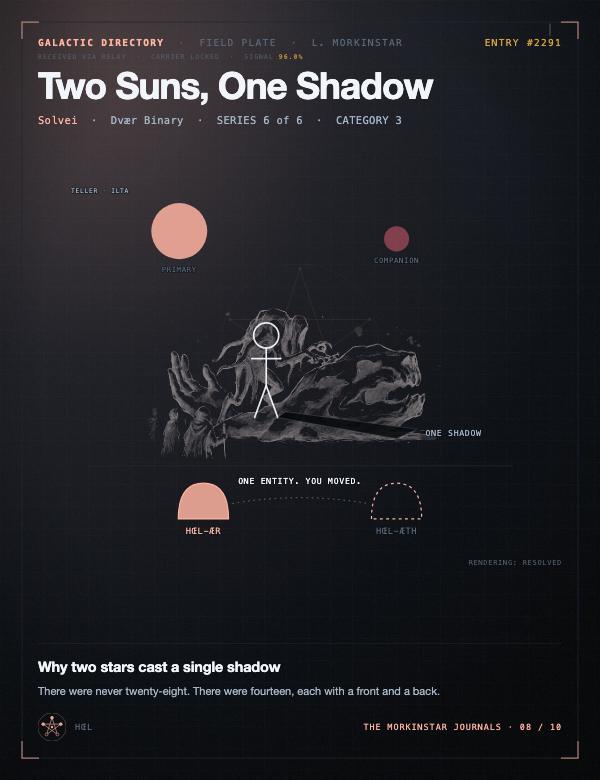
RELAY · GALACTIC DIRECTORY
Entry #2291 · Series 6 of 6, Dvær Binary
STATUS · RECEIVED
Greetings again, my dear readers. Lu'kifær Morkinstar, Journal Entry #2291, the last of six from the Dvær Binary, and I need about four hundred words of setup before this one starts making sense, so please bear with me.
Dvær is two stars. A yellow-white primary and a small sullen red companion, orbiting each other at a comfortable distance with a family of nine worlds going round the pair of them. Solvei is the fourth.
Solvei is pleasant. Warm, shallow seas, low mountains, no weather worth reporting. The Directory files the inhabitants as "Solveian", Category 3, and their own term for themselves is Tvænd, which the rig renders as "the turned".
There are two suns in the sky over Solvei for most of the day.
Everything on Solvei casts exactly one shadow.
I want to deal with the physics first and get it out of the way, because for once the Directory has actually done the work. The companion star is dim, distant, and red, and against the primary its contribution to surface illumination is small enough that the second shadow it casts is washed out to invisibility except at a few minutes either side of certain conjunctions. The optics desk sent me a two page note about it. The note is correct. Any child with a lamp and a candle can reproduce the effect on a tabletop.
So: two suns, one shadow, fully explained, no mystery, thank you and good night.
Except that the Tvænd have their own account of it, and their account is not a wrong guess at the astronomy. It is a description of the same fact from the other side, and I have never in 2291 entries had a myth and an instrument reading agree so precisely while sharing not one single term, and I am going to spend the rest of this entry on it because it broke something open for me.
Here is the thing about Tvænd.
They do not have a word for god and a word for monster. They have one word.
The word is hœl. It takes two inflections. Hœl-ær is the one you would translate as god. Hœl-æth is the one you would translate as monster.
And the inflection does not describe the entity. It describes where the speaker was standing.
I want to be extremely careful here because I am not a linguist and the rig is only a rig. This is not a word with two senses, and it is not moral relativism dressed up in grammar, which was my first assumption and which a Tvænd scholar corrected with something close to pity. It is a locative, the same class of inflection Tvænd uses for upstream and downstream.
Hœl-ær means that thing, from in front. Hœl-æth means that thing, from behind.
Now.
Regular readers of this series will have noticed something and I am going to say it out loud because I have checked it four times and had two independent desks check it after me.
Ær and æth.
Those are the Marltain morphemes. First-drawn and second-drawn. Brixby System. I filed them in Entry #2263 and I filed the correction to the Directory myself.
Brixby and Dvær are not neighbours. There is no trade, no contact, no shared substrate, no plausible transfer mechanism, and the two languages are unrelated in every other respect down to their phonologies.
One shared morpheme pair is a coincidence. I know that. I have said so in print. Two languages will occasionally produce the same handful of sounds for the same handful of very basic relations, and anyone who builds a theory on one coincidence deserves the career they get.
I am recording it. That is all I am doing. It is on the second page at the back of my logbook, underneath the tallies, and it is the first entry on that page that is not a number.
The legend.
Many milgalaxals ago, in what the Tvænd call the Standing, the world of Solvei was held between 14 gods and 14 monsters.
Except that on Solvei this sentence is a joke.
It is, specifically, a joke about foreigners. It is how a Tvænd storyteller opens the tale when there is an offworlder in the audience, and the whole room enjoys it, and the storyteller lets it sit, and then delivers the actual line, which is:
There were fourteen.
Not fourteen and fourteen. Fourteen. Each of them with a front and a back.
The Tvænd position, and they hold it with total seriousness outside the joke, is that every other world in the sky has counted the same fourteen entities twice and then congratulated itself on a full pantheon. Hœl-ær from the front, hœl-æth from behind, and if you had never thought to walk around one you would obviously conclude there were twenty-eight of them.
You can see, I hope, why I have not slept properly.
Their central story is about a woman called Ilta, and it is short, and it is the least eventful legend I have collected in this entire run.
Ilta walked around to the other side.
That is the plot. One of the fourteen was present in the world, doing whatever it is they do, being hœl-ær to everybody who was watching. And Ilta, who is described in every telling as unremarkable and in most as slightly annoying, did not stand where the others were standing. She walked around behind it.
And what she saw was not another face. That is the whole point and the storytellers make a meal of it. It was not two-faced, not a trick, not a disguise. It was one thing, and she was standing in a different place, and from there it was hœl-æth, and everything the front of it had been giving them the back of it was taking, and it was doing both with the same motion, the way an arm that pulls a rope towards you pushes it away from someone on the other side.
She told them. That is the second half of the plot. She came back and told everybody, and enough of them went and looked that for the first time in the history of Solvei the fourteen were observed simultaneously from both sides.
And they could not be both at once, in front of witnesses, and so they split.
[Fun Solvei Fact #9- The Tvænd word for a formal proof and the Tvænd word for an ambush share a root. The scholar who told me this was quite pleased with himself about it and, having now been on the receiving end of this legend, so he should be. I only got the joke on the second explanation.]
The Tvænd do not regard the split as a victory. This is the part I want to land properly.
Every other world I have filed treats its halving as the moment the story is won. K'öæluæ split and the war ended. Ösrun split and gave away his name and the war ended. Anh-Rekk split and became a fire that a civilisation still lights. Vör-Angi split and split and split until there was not enough of him anywhere, and even that the Hraedh tell as a defence that held.
On Solvei, the split is the catastrophe. It is the fall. Before Ilta there were fourteen things that were difficult to talk about, and after Ilta there were twenty-eight lines on two lists that were easy to talk about and wrong. The Tvænd say they traded a true theology they could not use for a usable one that lies, and that everyone in the sky is now running the cheap version, and that this is why the rest of us are all so confused about the fourteenth.
I did not ask about the fourteenth. I want to be clear about that. Eight worlds, six systems, and it is the second time I have not had to, and the first time somebody volunteered it without being asked at all.
The storyteller brought it up, unprompted, as an aside, in the tone you would use for the least interesting part of a story you have told a thousand times.
Thirteen of the fourteen split. One did not.
One of them is not built the way the other thirteen are. Front and back are the same face on that one, so there was never another side to walk around to, and nothing to split, because splitting takes two things to separate and this one only ever had the one. It is the patron of order, of records, of endings, of rest, and most people who meet it are glad of it, so its name went straight onto the list of gods. And the very same motion, seen from wherever somebody else happens to be standing, is the ending of everything, the way an arm that pulls a rope towards you pushes it away from someone on the other side. So it holds a line on the monster list too. It just does not have a second name to put on it.
It has no name on the monster lists, the storyteller said, because its name is already on the other one.
I want to stop here for a second, my dear readers, and bury something I have been quietly nursing since somewhere around the Marlt correction in Entry #2263. I have been calling it the Template Hypothesis, and the shape of it was this: the fourteen is not real, it is administrative. Some early surveyor's classification form had fourteen slots for gods and fourteen for monsters, and every field officer since has been dutifully filling them in because that is what the form asks for and nobody questions a form. Or, failing that, it is my own rig, quietly normalising whatever count a world hands me into a shape I already recognise, the way a coin worn smooth in enough pockets ends up looking like every other coin. Either way, the fourteen would be paperwork. Mine, or somebody's before me. And paperwork I know how to be angry about. It felt, frankly, like the only professional posture available to a man who keeps finding the same number where it has no business being.
And the Tvænd, without being asked, without even knowing they were doing it, have just killed that idea stone dead, and I want to write down exactly how it died so that I cannot later pretend it was gentler than it was. The fourteen on Solvei is not a form. It is not my rig smoothing anything. It is not a clerical artifact at all, and it never once occurred to me, in five entries of very thorough auditing, that it might not be a clerical anything, because clerical is a category I understand and know how to fight. What the Tvænd have described instead is a count that is an artifact of where you are standing. Hœl-ær and hœl-æth are not two things badly recorded as one, and they are not one thing generously recorded as two. They are one thing, seen from two places, and the fourteen only ever needed a form to hide behind because everybody who met it, including me, went looking for the desk that produced it.
There was no desk. That is what I am closing the file on tonight. Five entries I spent proving my own employer sloppy, building it correction by correction like a case for a tribunal, and the answer was never in the building. It was not about the Directory at all, not this time, and I am not sure I have ever been so thoroughly wrong in a direction that taught me quite this much. The Template Hypothesis is dead. I am not amending it and I am not filing a correction to my own correction. I am closing it, the way you close a file on a suspect who turns out to have an alibi for the whole night, and going back to wondering who else was in the room.
I sat with that for a long time. And then I got the logbook out and did the sum, because I am the sort of person who does the sum.
Thirteen of them split. Each of those thirteen gives you a face at the front and a face at the back, which is a god and a monster, which is twenty-six names.
The fourteenth did not split. It has one name.
Thirteen gods plus that one is fourteen gods. Thirteen monsters plus the line where the fourteenth ought to be is fourteen monsters. Twenty-eight entries across the two lists and only twenty-seven names to fill them, because one of the fourteen is filed on both and can only sign once.
And that is the pause. That is the thing I have been chasing across six systems and two pages of a logbook, and it is not a taboo and it is not a fear and nobody has been hiding it from me. Every monster list in the sky has fourteen lines and thirteen names on it because the fourteenth line is a cross-reference. It always was. No culture up here has ever worked out what it points at, because to work that out you have to go and stand behind a god, and in the whole recorded history of everywhere, one slightly annoying woman has thought of it.
I did the sum four times. It comes out. I would have preferred it not to.
I am not going to draw the rest of the conclusion for you. I have a rule about that and I have already broken enough of my rules in this series. I will lay out what I have, in the order I got it, and you can do what you like with it.
Six worlds gave me fourteen and fourteen and thirteen names.
A mason on Jötunheimr told me the fourteenth is not one of theirs, because it is on everyone's list.
A custodian on Cendre showed me a child's page four thousand clicks old with a single word on it, and I read it and did not copy it, and I stand by that and I am not going to relitigate it.
And a storyteller on Solvei has now told me, as a throwaway, that the reason nobody has a name for the fourteenth monster is that everybody already has one for it, filed on the opposite page, under the gods.
That is either the most elegant thing I have ever been told or it is a very old joke that a great many worlds have independently fallen for, and I genuinely do not know which, and I have never in my professional life been so uninterested in finding out safely.
One last thing and then I will let you go.
I asked the storyteller why the shadow. Two suns, one shadow. I wanted the mythological version to put next to the optics desk's two page note.
He took me outside. It was the middle of the day and both stars were up and my own shadow was lying on the ground in front of me, single, sharp, entirely ordinary.
He said: a shadow is what a thing looks like from behind the light.
Then he said that there are two suns and one shadow because there have always been two ways to stand and only ever one thing standing there, and that Solvei writes its whole theology on the ground every day at noon where a child can see it, and that the fact that a foreigner can explain the same shadow with a lamp and a candle does not make either of them wrong.
He is right. That is the thing I cannot get past. He is completely right, and so is the optics desk, and they have never once been in the same room.
Is there truth in their legend? No one knows. My aim is never to prove or disprove the tales I come across. Just to report them to you, my dear readers.
This is Lu'kifær Morkinstar concluding Journal Entry #2291, Series 6 of 6, and with it the Dvær Binary.
My next filing is going to be short. I want to warn you about that now so that when it arrives you do not assume something has happened to me.
Something has happened. Just not to me.
Terminologies:
- Click — Equivalent to 1 Hellheim or 2 Earth Years.
- Milgalaxal — Equivalent to 2228 Hellheims or 2455 Earth Years.
- Tvænd — Self-term of the Solveians. "The turned."
- Hœl-ær / hœl-æth — The same entity, from in front and from behind. Rendered by the Directory as god and monster since the first survey, which is not a translation so much as a decision.
- Ær / æth — See also Entry #2263, Marlt, Brixby System. I am recording this and nothing else.