The Directory · ENTRY #2277 · Jötunheimr, Ymirsgald
The Standing Dead
2,581 words · about 12 min
Back to The Morkinstar Journals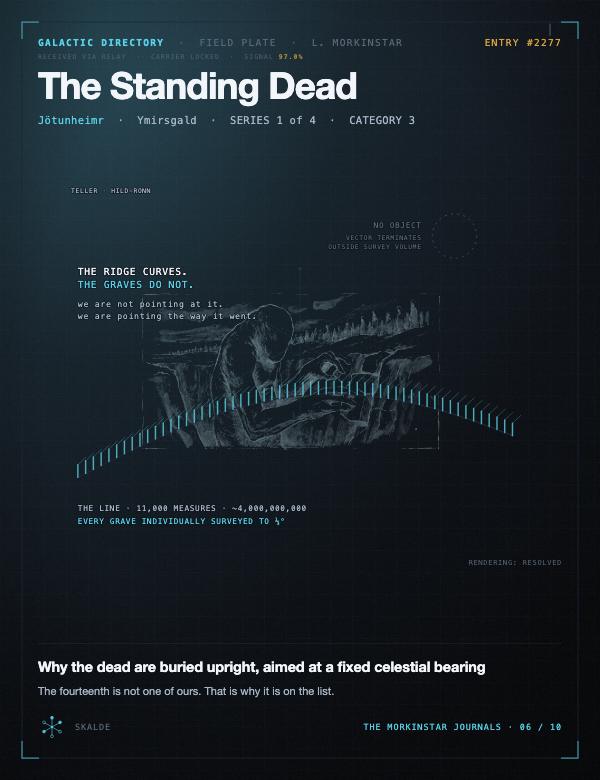
RELAY · GALACTIC DIRECTORY
Entry #2277 · Series 1 of 4, Ymirsgald System
STATUS · RECEIVED
Greetings again, my dear readers. Lu'kifær Morkinstar, and this is Journal Entry #2277, the first of four from the Ymirsgald System, filed from a world I have been mentioning in passing since Entry #2245 and putting off visiting for exactly as long.
Jötunheimr.
I have described it as "dangerous" before now, which is the sort of word a correspondent uses when he has not been somewhere and does not want to admit it. Having now been, I would like to upgrade the description. Jötunheimr is not dangerous the way a predator is dangerous. It is dangerous the way a machine with no guard rail is dangerous. Thin crust, active mantle, a magnetic field that comes and goes on about a nine-day cycle, and a 40 hour night on the far continent during which the surface temperature falls off a cliff and the auroral activity gets bright enough to read by.
Category 3, comfortably. Directory term for the inhabitants is "Jötunheimri". Their own is Hraedh, which the rig gives me as "the standing", and which their own scholars will tell you is better rendered as "the fence".
They are enormous, unhurried, and courteous in the specific way of people who have never in their history had a reason to be in a rush. Excellent stonework. Best I have seen in four systems.
And they bury their dead upright.
Not seated, not entombed, not interred in the several dozen configurations I have catalogued elsewhere. Standing. Feet on the floor of the shaft, spine vertical, chin level, in a lined stone sleeve sunk to a depth that leaves the crown of the head about a hand below the surface. A Hraedh grave from above is a circle of fitted stone the width of a shoulder. From the side, if you could see it, it is a person, still on their feet, waiting.
There are somewhere in the region of four billion of them.
They are in a line.
Not a graveyard. A line. It runs along the terminator ridge of their inhabited continent, and it is, at last survey, 11,000 galactic standard measures long, and it is between forty and two hundred graves deep depending on how bad a given millennium was, and it is still being extended at both ends, by hand, by teams whose job title translates as "the masons of the far end".
You do not choose to be in it. Every Hraedh who dies goes into the line. There is no alternative rite. There is not a word for one.
And every single one of them faces the same way.
Here is the legend.
Many milgalaxals ago, in what the Hraedh call the Long Night, the world of Jötunheimr was held between 14 gods and 14 monsters.
Sixth world. Fourth system. The page is full. I have started a second one.
The god here is Vör-Angi, the Warden, and the monster is Skalde, which the Hraedh describe as a cold that walks in on the dark side and takes what it finds standing still.
Skalde is not a fighter. This is important and every rendition leads with it. Skalde does not attack a defended place. Skalde goes around. Skalde finds the gap, and there is always a gap, because a perimeter is a very long thing and a monster is a very small one.
And Vör-Angi could hold any point on that perimeter absolutely. Nothing in the Long Night could get past him. That was never the problem.
The problem was that the perimeter was 11,000 measures long and he was one.
So he split himself in half, and put one half at each end.
And Skalde came in between them.
So he split each half in half, and now there were four, and the gaps were half as wide, and Skalde came in between.
And this is the entire second act of the legend, my dear readers, and it goes on for what in the recitation is close to an hour, and it is the most upsetting piece of arithmetic I have ever heard set to music. He halves. The gaps halve. Skalde comes in between. He halves again.
Every other legend I have filed in this series has a halving in it exactly once, and it ends the war. On Exxobar, K'öæluæ split in two, burned both, and it was over. On Grïnjdarlay, Ösrun split in two, gave away his arms and his name, and it was over.
On Jötunheimr the halving is not a sacrifice. It is a strategy, and it is applied recursively, and the story is honest enough to show you what recursive sacrifice actually converges to.
By the end of it Vör-Angi is spread along the whole ridge in pieces too small to stop anything. He is everywhere on that line and there is not enough of him anywhere on it to matter. He has not died. There is no death scene. He has been divided into an amount of god that rounds to nothing, which is a worse ending, and the Hraedh know it is a worse ending, and they tell it that way on purpose.
What stopped Skalde was a woman named Hild-Ronn, who was not a hero, who was a mason.
She looked at the line of failing god-fragments and observed, correctly, that the problem was not power. The problem was presence. The line needed to be occupied. It did not need to be occupied by anything strong. It needed to be occupied by something that would not leave.
And the one resource Jötunheimr has never once run short of is people who are finished moving.
She dug the first shaft herself and put her own mother in it, upright, and set the stone, and then she went and got the next one.
[Fun Jötunheimr Fact #3- The Hraedh have no word for "cemetery", "tomb", or "monument". The line is administratively classified under public works, is maintained out of the same budget as the roads, and the masons of the far end are civil servants with a pension. I asked one whether that felt strange. He asked me what else it would be. I did not have an answer. I still don't.]
Now.
The bearing.
I want to walk you through this carefully because I have gone over it four times and I would like you to check my working.
Every grave in the line faces the same direction. I assumed, as anyone would, that they face outward from the ridge, or toward the pole, or along the line itself, or toward the capital. None of those. The ridge curves. The line curves with it. And the graves do not curve.
They are all aimed at the same celestial bearing. A fixed point in the sky.
Which means, and I want you to sit with this, that a planet rotates. And orbits. And precesses. And so a fixed celestial bearing is not a thing you can eyeball, or copy from the grave next to you, or set once and reuse. Every single interment on that ridge has been individually surveyed, at the hour of burial, against the sky, and set to within what my instruments read as a third of a degree.
Four billion graves. Four thousand clicks. Each one aimed.
The masons of the far end carry an instrument for it. It is the oldest continuously used design on the planet, older than their alphabet, and they still make them out of stone because a stone one does not care about the magnetic field, which on Jötunheimr comes and goes.
So naturally I asked my ship to plot the bearing and tell me what is out there.
There is nothing out there.
No star inside instrument range. No cluster, no remnant, no dark body my sensors will admit to. My ship, which is not an imaginative machine, returned the plot with the annotation no object; vector terminates outside survey volume and then asked me if I wanted to run it again with a wider aperture, which I did, twice, and the answer did not change.
I took this to the senior mason. I said, as delicately as I could manage, that I had checked, and that their line is aimed at empty sky.
He said I had misunderstood the question. He said, and the rig is confident here:
"We are not pointing at it. We are pointing the way it went."
Skalde was not killed. There is no kill in this legend either, you will have noticed. Skalde withdrew, off the ridge and off the dark side and, in the Hraedh account, off the world. And the line faces the direction it left in, because the Hraedh's entire theory of defence, the one thing Hild-Ronn understood that a god did not, is that a thing which leaves in a direction is a thing that has a direction to come back from.
So they aim. Every grave, every time, for four thousand clicks, at a patch of sky with nothing in it, on the reasoning that the absence of a target is not evidence of the absence of a thing, and that a fence you stop maintaining is a fence.
I have run the same bearing question at the Directory's survey desk against my previous stops. I am not going to report the result in this entry, because I have one data point and one data point is a rumour. And I am not letting go of it either. I am going to keep taking the measurement at every world in this series where anything is aimed at anything, all the way through to the fourth entry from this system, and if it turns into a pattern I will tell you, and if it does not I will tell you that too.
The last thing.
I asked the senior mason to name the fourteen monsters. Sixth world I have asked. I could recite the shape of the answer by now: thirteen names, then the pause, then the change of subject.
He gave me thirteen names. Then he gave me the pause.
And then he did something none of the others did. He did not change the subject. He looked at me for a while, the way the Marltain woman looked at me before she told me my pair was running late, and he said:
"The fourteenth is not one of ours."
I asked what that meant.
He said: the other thirteen are Jötunheimri. They were born here, they belong to this world, they are on the list because they are ours and a people should know the names of what is theirs.
The fourteenth is on the list because it is on everyone's list.
That is why he could not name it. Not taboo. Not fear. He has no name for it because it is not his to name, in the way that you do not have a family name for a thing that visits every family.
Six worlds. Four systems. No contact. Fourteen monsters each, thirteen names each, and now, for the first time, someone telling me why.
Is there truth in their legend? No one knows. My aim is never to prove or disprove the tales I come across. Just to report them to you, my dear readers, as accurately as I can, on good material, in duplicate.
This is Lu'kifær Morkinstar concluding Journal Entry #2277, Series 1 of 4 from the Ymirsgald System.
I stood on the ridge for a while before I left. It is very quiet up there and the line goes off in both directions until it stops being a line and starts being a horizon, and every single face on it is pointed at the same handful of empty sky, and I stood there long enough to notice that I had turned around and was facing that way too.
And here is where I owe you the honest version, my dear readers, because in Entry #2263 I set myself a test and I am now obligated to sit for the results. I said, in that entry, that the day I found the count of fourteen fixed into something older than writing, in a place no classification form had ever been near, on a world the Directory only got around to surveying comparatively recently, I would call the Template Hypothesis dead and say so in the very next entry I filed. That was the deal I made with myself, in writing, on the record. Well. At the founding end of the line, the near end, the oldest section, the coping stone over Hild-Ronn's own mother reads fourteen notches cut side by side, worn nearly flat, older by the senior mason's own reckoning than the Hraedh had letters to write the number any other way. Nobody's field officer stood over that shaft with a form. There was no form yet. There was barely a language yet. The count was already there.
So the hypothesis, as I filed it, is dead, and I would like to say that plainly rather than talk around it: an early Directory survey did not hand Jötunheimr its fourteen, because Jötunheimr had its fourteen before there was a Directory to hand it anything. What I am not ready to do, and I notice this about myself with some discomfort, is let go of the shape of the idea, only its direction. Here is the patch, and I can hear how much weaker it is than the original the moment I say it out loud: maybe the count did not come off a form at all. Maybe it came off my rig, and off every rig, and every translator built in the last sixty galaxals shares a lineage and a bad habit, and what I have been collecting for six worlds is not fourteen cultures agreeing but one machine rounding fourteen different numbers into a shape I can read. It explains less than the original did. It requires an infection I cannot name, at a contact I have no record of, running the wrong way down a timeline I cannot prove. But it keeps the shape of an answer, and up on that ridge I would rather keep a weak answer than stand there with none.
I will admit I stood there rather longer than the walk back to the ship required, and that my hands went looking for something to hold even though there was nothing worth holding onto that the mason wasn't already fairly attached to. (He was very polite about moving me off the coping stone. I got the distinct sense it was not the first time he'd had to do that to a visiting correspondent.) A man who has spent a season cataloguing his own employer's sloppiness, the Marlt binary, the Killugan hold, the Vaehn assessment, and I am still not touching the milgalaxal conversion, likes to think of himself as unshockable on the subject of Directory paperwork. Turns out I am shockable. I had just been expecting the shock to arrive from the other direction.
Terminologies:
- Click — Equivalent to 1 Hellheim or 2 Earth Years.
- Momenta — Equivalent to 1 Purgaheim or 50 Earth Days.
- Milgalaxal — Equivalent to 2228 Hellheims or 2455 Earth Years.
- Hraedh — Self-term of the Jötunheimri. "The standing", better rendered "the fence".
- The Line — Their word is Vörth, which is also their word for a load-bearing wall.