The Directory · ENTRY #2259 · Vædrun, Alpha Axmoiri
The Tide That Owes
1,988 words · about 9 min
Back to The Morkinstar Journals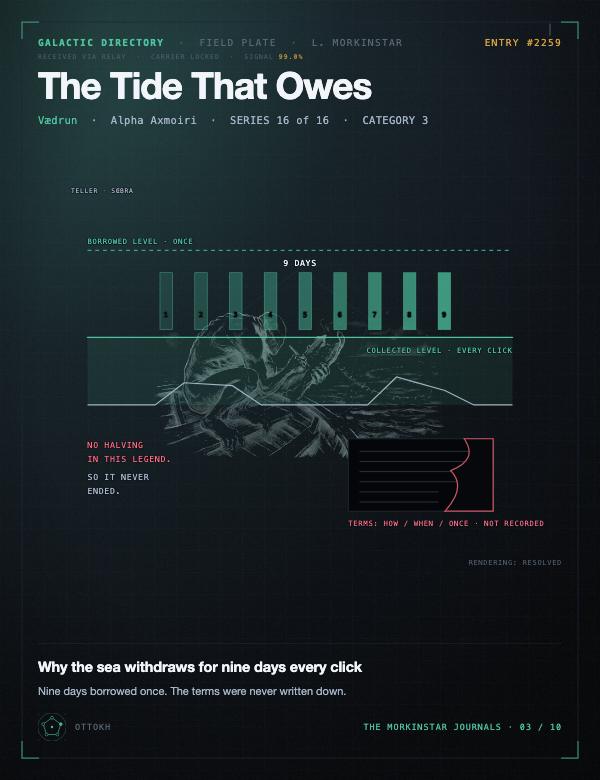
RELAY · GALACTIC DIRECTORY
Entry #2259 · Series 16 of 16, Alpha Axmoiri System
STATUS · RECEIVED
Greetings again, my dear readers. This is Lu'kifær Morkinstar, and this is Journal Entry #2259, which closes out my Alpha Axmoiri series. Sixteen of sixteen. If you have been with me since Entry #2241 then you have been on this yellow giant's family of worlds for the better part of a click and I appreciate the company more than my publisher does.
We finish where I should probably have started, on the 9th planet, Vædrun.
Vædrun is an ocean world. Not a world with a large ocean. An ocean, with some inconvenient rock poking through it in eleven places. The Galactic Directory lists the inhabitants as "Vædrunai", Category 3, no spaceflight, extremely good boats. Their own term for themselves is Sülm, which the rig gives me as "those who wait", and unlike most self-terms I encounter, which tend to mean something flattering like "the true people" or "the ones who are correct", the Sülm chose theirs on purpose and they will tell you exactly what they are waiting for if you have nine days.
Which is the number that runs this entry.
Once every click, the sea on Vædrun goes out. Not a spring tide. Not a seasonal drift. It withdraws by an average of 40 galactic standard measures across every coast on the planet simultaneously, holds there for nine days, and then comes back. Their fleets are built to be beached. Their cities are built on the assumption. And every structure on Vædrun below the high line has legs.
Now, I am a reporter and not a tidal physicist, but I did put the question to the Directory's orbital mechanics desk, and I want to be honest with you about the answer, because it is the reason I stayed. They ran it. Vædrun has two moons in a perfectly ordinary arrangement and a star doing nothing unusual, and there is no configuration in that system that produces a nine day planet-wide withdrawal. They ran it four times. Then they stopped answering my messages, which in my experience is the sound a physicist makes when they are annoyed.
So. The legend.
Many milgalaxals ago, in what the Sülm call the Dry, the world of Vædrun was held between 14 gods and 14 monsters.
I am going to stop pretending I have not noticed. That is the third world in this system to give me that census. Exxobar: fourteen and fourteen. Grïnjdarlay: fourteen and fourteen. Vædrun: fourteen and fourteen. Three unconnected Category 3 cultures on three planets that have never so much as exchanged a radio squawk, and they agree on the headcount of the divine to the individual.
I have started a page at the back of my logbook. It has three tallies on it. That is all it has, and that is all I am going to say about it until it has more.
And here is my guess, my dear readers, and I will admit I am relieved to have one: contamination. Not the worlds agreeing, the paperwork agreeing: some early surveyor's classification form with fourteen slots for gods and fourteen for monsters that every field officer since has dutifully filled in, or my own translation rig quietly normalising every foreign count into a shape it already recognises, or three centuries of correspondents copying the correspondent before them without ever checking the sums. It is the boring answer, and in my experience the boring answer is usually the right one.
Of Vædrun's fourteen and fourteen, this legend needs two. The god Ottokh, who is the tide, and the monster Vaal-Ne, called the Long Dry, which the Sülm describe not as a creature but as a thirst that got large enough to have opinions.
Vaal-Ne came up out of the eleven rocks and drank. It drank the shallows first, then the shoals, then the fish, and then the Sülm. And here is the detail that tells you what kind of story we are in: Vaal-Ne was not cruel. Vaal-Ne was thirsty. Every version of this legend I collected, and I collected nine, is careful to say so. The Sülm have no interest in a villain. They are interested in an obligation, and you will see why.
The Sülm of that age were led by a fisher-queen named Ilbrekh, and Ilbrekh did what the Sülm still do when a problem is bigger than a boat: she rowed out past the last rock and she asked.
Ottokh came up. And Ilbrekh asked him for nine days of tide.
Not a flood. Not a weapon. Nine days in which the sea would stand up over the eleven rocks and hold, so that Vaal-Ne, which lived in the dry, would have nowhere to be. Nine days is what her navigators calculated it would take. Nine days exactly, and the Sülm would take their fleet up onto the high ground and wait it out.
And Ottokh, who by every account in this legend is the most reasonable entity in it, said yes.
Then he said the other thing. He said: this is a loan.
[Fun Vædrun Fact #12- The Sülm word for "gift" and the Sülm word for "trap" share a root. This is not a coincidence and they are quite happy to explain it to visitors at length, generally while you are eating. I do not speak a word of Sülm myself, I just nod at the right moments and trust the rig. I guess.]
The sea stood up for nine days. Vaal-Ne had nowhere to be dry in, and thirst without anywhere to be is just weather, and it went. When the water came down, the eleven rocks had eleven finger-widths of silt on them, and the Sülm, who had been a fishing people and nothing else, came down off the high ground and discovered they were now also a farming people. Vædrun's entire agricultural tradition dates from that nine days. Every crop they grow, they grow in Vaal-Ne's grave.
So they had a festival. Of course they did. You would have too.
And now I have to tell you about Sœbra.
Sœbra was Ilbrekh's tallykeeper. Not a priest, not a hero, a clerk. Her job was the bark scroll on which the Sülm recorded quantities, and she was aboard the boat when the queen made the ask, and she wrote the agreement down as it happened, in the shorthand clerks use, on wet bark, in a hurry.
Nine days. Loaned. To be repaid.
That is what the scroll said. Every rendition agrees. And I want you to notice, my dear readers, the three things that scroll did not say, because the Sülm certainly noticed and they have had four thousand clicks to think about it.
It did not say how. It did not say when. And it did not say once.
The scroll went into the festival bonfire. Not maliciously. Not even carelessly, exactly. Bark was what they had, and bark was also what burned, and it was the ninth night and everyone was extremely glad to be alive. Sœbra is recorded as having pulled it out and stamped the fire off it and having been laughed at, and then having gone to bed, and the version I like best has her writing it out again from memory the next morning, on better material, and the version I believe has her failing to, because nobody who has ever kept a tally in their life recovers a burnt one accurately and pretends otherwise.
Fifteen clicks later, the sea went out for nine days.
And came back.
And a click after that, it went out for nine days again.
The Sülm sent everyone. Priests, then the queen's daughter, then eventually, and I find this genuinely moving, they sent clerks. Boat after boat of tallykeepers rowing out past the last rock with better and better documentation, asking Ottokh what the terms were, and Ottokh, who is not malicious, who is the single most reasonable entity in this entire legend, gives the same answer every time.
He says: you borrowed nine days of tide. I am taking nine days of tide. Show me the paper that says how many times.
They cannot. It burned.
And so the sea on Vædrun goes out for nine days, every click, forever, on a debt of nine days taken once, because the only enforceable reading of an agreement with no end date is that it does not have one.
Now here is the thing that made me put my stylus down.
I have filed two other legends from this system. On Exxobar, K'öæluæ split himself in two and burned both halves and the war ended. On Grïnjdarlay, Ösrun split himself in two and gave away his arms and his name and the war ended. Both of those stories cost somebody half of themselves, and both of them stopped.
Nobody on Vædrun split anything. Nobody sacrificed. Everybody behaved sensibly and gratefully, the monster was beaten cleanly, there is no tragedy in it anywhere, and it is the only one of the three that is still running. Four thousand clicks later. Nine days at a time. With the debtors' descendants building their houses on legs to accommodate the payments.
I do not have a thesis. I have a page at the back of my logbook with three tallies on it and now a second page with a note on it that says the ones that end, end because someone halved.
The Sülm, for their part, are not bitter about it. That surprised me and it should surprise you. They call themselves "those who wait" and what they are waiting for is not relief, it is the sea. Every nine days of Withdrawal, the entire population goes down onto the exposed floor of their own ocean and walks around on it, and picks things up, and looks at the wrecks of the boats of everyone who came before them, and comes back up before it fills. It is their most important cultural period. It is when they get married. Children born during a Withdrawal are considered lucky and are traditionally raised as clerks.
Sœbra is in the pantheon, by the way. She was added late, roughly 900 clicks after the fact, by popular pressure, over the objections of the priesthood who pointed out reasonably enough that she was the one who lost the paper.
The Sülm added her anyway. Their argument, as it was put to me by a woman gutting a fish on a beach that had been the sea floor two days earlier, was this: everyone else in the story did something. Sœbra is the only one who wrote it down, and the fact that the record burned does not make the keeping of it worthless. It makes it the most valuable thing anyone did that day, which is exactly how you know it was worth doing.
She is the fifteenth god. Vædrun is the only world in Alpha Axmoiri with fifteen.
Is there truth in their legend? No one knows. My aim is never to prove or disprove the tales I come across. Just to report them to you, my dear readers, and to keep my own tally on good material, in duplicate, well away from the fire.
This is Lu'kifær Morkinstar concluding Journal Entry #2259, Series 16 of 16, and with it the Alpha Axmoiri System. Next stop, the Brixby System, where I am reliably informed the locals are born in pairs and find the rest of us upsetting.
Terminologies:
- Click — Equivalent to 1 Hellheim or 2 Earth Years.
- Momenta — Equivalent to 1 Purgaheim or 50 Earth Days.
- Milgalaxal — Equivalent to 2228 Hellheims or 2455 Earth Years.
- The Withdrawal — The nine day Vædrunai low tide. Sülm term is Ottokh-sal, "the collection".
- Sülm — Self-term of the Vædrunai. "Those who wait."