The Kindling · PAGE 12 WITHDRAWN
A World That Asks The Dead One Question
798 words · about 4 min
Back to The Morkinstar Journals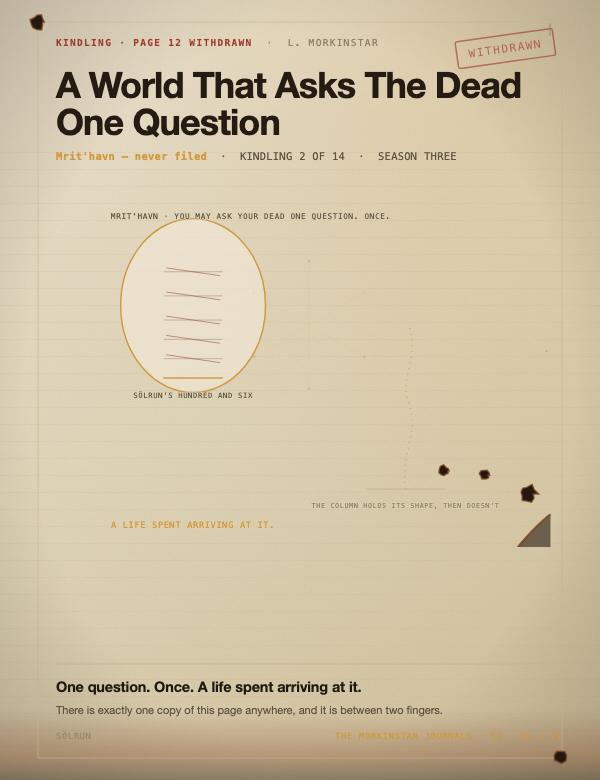
Kindling · page 12 withdrawn
Greetings again, my dear readers. Page twelve.
I want to say this up front, because it will save us both some grief in a minute: you have never read this one. Every page so far, you at least half recognised, a name filed away somewhere, a wall you remembered the number on. Not this. This is a page I wrote and put away and never sent anywhere, because by the time I wrote it I had already stopped filing, and there is no copy of it sitting nine decks down in a drawer with my name on it, and there is no copy of it anywhere else at all. There is exactly one, and it is currently between two fingers, and it is not going to stay there.
So. Quickly, because that is all the time it gets.
(And while I have you: no, I am not telling you about every page that goes into this fire. Some go in while I am doing something else entirely and only find out after, from the slot. I am only stopping the account for the ones that stop me. This one did.)
There is a world (I am not telling you where; "where" stopped meaning very much to me somewhere around slot sixty, and I am letting that go for now) that the Directory filed forty galaxals ago as "post-mortem interrogative practice, Category 3, low priority" and never once looked at again. They call themselves, in their own tongue, the once-asking. If you want the sad version of that, and you always want the sad version from me, it means something closer to "those who only get one." Because on Mrit'havn you may ask your dead exactly one question. Once. Ever. And a whole life there gets spent arriving at it.
They hand you the stone at seven. An eiðrstan, palm sized, nothing carved on it yet, and you carry it the rest of your days and scratch your question into it the moment you think you have found it, and then, inevitably, scratch it back out and start again, because you are seven, or you are eleven, or you are forty, and it is never quite the right one. Some people's stones go soft and round as river glass by the time they die, worn smooth by their own handwriting arguing with itself for sixty years. Whatever is still legible the hour they go is the one their family gets. Once. At the burying, when the fire under the resting frame throws its first real column of smoke, and the dead, for exactly as long as that column keeps its shape, will answer.
I have a witness for this one. A woman named Sölrun, who tended burnings for forty years and never asked her own. Not for lack of a question. She had, by her own count, one hundred and six of them, and could not get the stone down past three lines, and she told me, very matter of fact, that she had decided it was better to die with the wrong hundred than bury the one right one underneath all the others. So she sat with other people's smoke instead. She told me a few of the things people asked. I wrote three of them down on this page, in her words, because that was the thing on it nobody had ever written down before, which was the only rule I was ever actually keeping.
Page twelve is going in now, while I still have both hands free to write about it, which will not last. It curls at the corner before it takes, the way paper does, and for about as long as that curl held its shape I found myself waiting, the way her families must have waited on the smoke. Nothing answered. That was always the difference between her fire and mine.
None of it has been written down anywhere now. That was the last true thing about this page, and it stopped being true about four seconds ago.
I went looking, just after, for what her hands looked like over that fire, whether forty years had made them steady. I remember deciding, at the time, that it was worth the ink. It was only ever on that page, and when I reached for it just now it was not there. I am not going to go looking for the rest of her.
My dear readers, I know that is an unsatisfying place to leave a woman with a hundred and six questions and a stone the size of a river pebble. I share the feeling. There is nothing either of us can do about it from here. The fire in front of me does not negotiate, and in the end, neither did hers.